
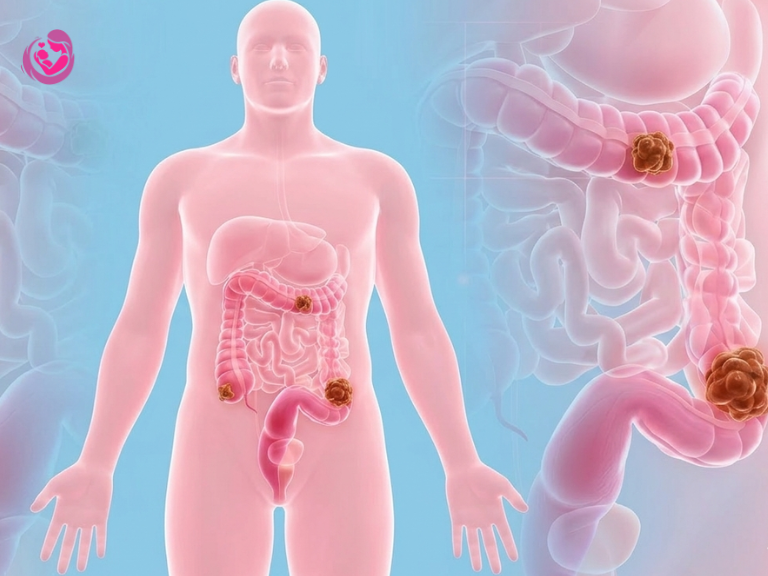
What is Colon Cancer Stages?
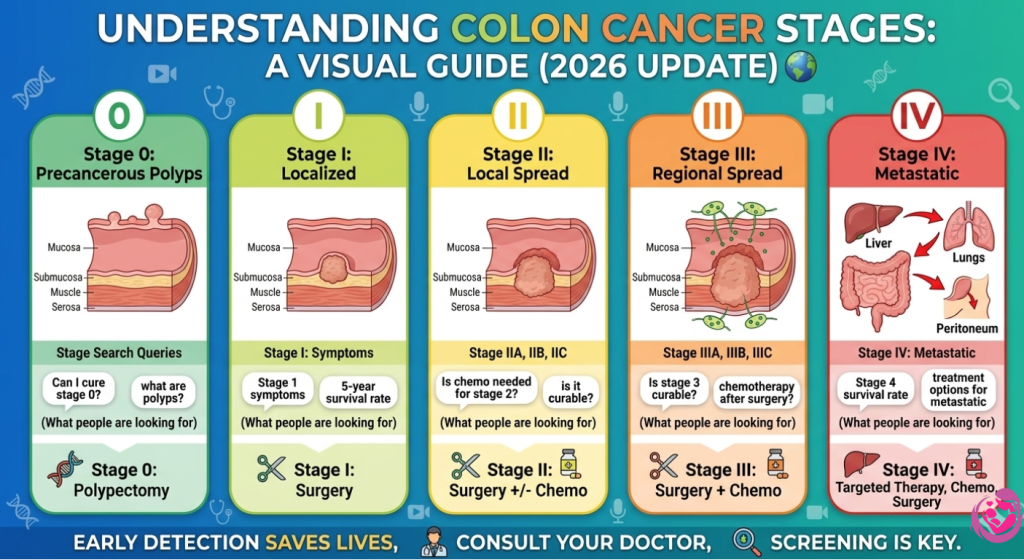
In order to describe the levels of colon cancer, we must leave to the conception of the oncologists in their classification of the diffusion of the cancer cells in the large intestine. The staging is the GPS of your medical staff. It tells them of the exact location of the cancer and the extent to which it has spread into the internal layers of the colon and whether it has begun a trip to other parts of the body. In 2026, the TNM system still remains the Tumour, Node and Metastasis that is abbreviated as TNM.
The colon cancer stages begin with the Stage 0 that is simply a cluster of the malign cells that are not as yet moved past the inside coating. The Stage 1 and Stage 2 are considered as localised and that is, the tumour is growing in the wall of the colon but it has not spread into the highway of the lymphatic system. Once the cancer has reached the lymph nodes, then it is regarded as Colon Cancer Stages 3
The final Colon Cancer Stages is the stage 4; this is a sign of metastatic disease i.e. the cancer has done in other body parts like liver or lung. This phase is important as management of Stage 1 is highly dissimilar to the systemic treatment that will be required at the advanced phases of colon cancer
Stage 1 Colon Cancer Symptoms
The most unfortunate thing about the first stage is that at the stage 1, the symptoms of colon cancer are usually absent. At this phase, the tumour is localised and only covers the inner layers of the colon wall. Being a relatively wide organ, a small growth will not normally hinder and cause significant pain. This is exactly why screenings are as often as possible in the USA; even the Colon Cancer Stages 1 tumour could be identified by a physician during an ordinary colonoscopy long before a patient felt anything wrong.
However, other patients may observe rather minor changes. These stage 1 colon cancer symptoms might include a slight alteration in the frequency of peeing or a general sense of abdominal fullness, which does not seem to increase with the use of over-the-counter antacids. Another common symptom is occult blood, which is the blood hidden in the stool that cannot be seen with the naked eye, but only under a microscope when the faecal examination was conducted. These symptoms are so mild to the point that it can be regarded as stress or change in diet and clinical screening is the only certain way of observing the disease in its initial Colon Cancer Stages
Stage 3 Colon Cancer
When a diagnosis reaches stage 3 colon cancer, this means that the disease has already reached the Colon Cancer Stages of a region. It means that the primary tumour has passed through the muscular layers of the colon and it already has managed to invest in the lymph nodes that are in its immediate surroundings. The lymph nodes are likened to the philtres to the immune system in the body and when the cancer cells are introduced to the lymph nodes, there is always more likelihood that the same may spread further in future.
Oncologists further break down 3 Colon Cancer Stages into stage A, B and C in 2026 depending on the size of the affected lumps and the amount that the original tumour had spread to. Despite the fact that this stage is more serious as compared to the earlier stages of colon cancer, it is a stage in which medical intervention is fierce and most effective. The level not only focuses on controlling the disease, but to eradicate it totally through physical removal and cleaning up in conjunction with chemicals.
Is Stage 3 Curing of Colon Cancer?
The question regarding the most urgent patients issue is the following: Is it possible to cure Colon Cancer Stages 3? Yes will be the final yes or no in 2026. Despite the scare the word cancer has, Stage 3 remains a disease that is as yet curable. The treatment is usually initiated by surgical intervention to remove the part of the colon that contains the tumour and at least 12 adjoining lymph nodes in an effort to get clean margins.
The curative stage of treatment of stage 3 colon cancer, started after surgery, requires chemotherapy almost constantly. This is termed as adjuvant therapy. It is done to eliminate any microscopic cancerous cells that might have previously gotten away in a different location before the operation. The diets of the contemporary 2026 are now far more acceptable and effective bringing the percentages of success much higher. When people ask the questions, is colon cancer treatable at stage 3, they will know that there are thousands and thousands of people who survived in the USA alone, which is giving evidence to the fact that even at Colon Cancer Stages 3, stage 3 is treatable with the help of appropriate medical programe.
Stage 4 Survival rate of colon cancer
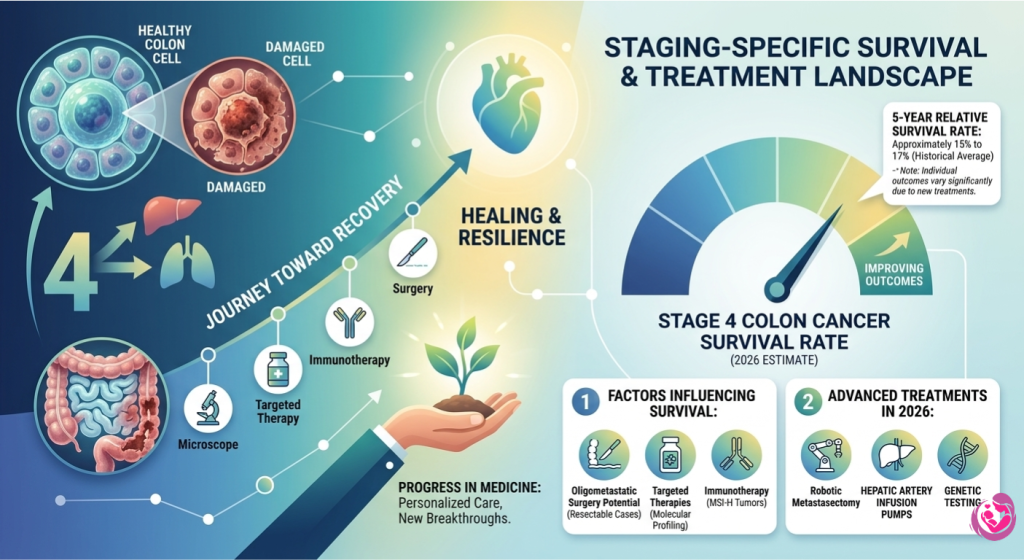
Due to the fact that there has to be balance between clinical candour and modern hope when speaking about the stage 4 colon cancer survival rate. The fourthColon Cancer Stages means that the cancer has spread to distant areas, in most cases, the liver. This was traditionally thought of as being something to be extremely frightened of and with the better technology that has been developed in the targeted therapy and immunotherapy, the survival rates have been increasing.
The current 4 5-year colon cancer survival with the general population is estimated at about 15 to 17 percent. These figures are deceitful however. The case in point is that any patient of cancer whose cancer is confined to isolated spot in the liver that can be removed through surgery has a far better prognosis as compared to the patient with widespread disease disease. It is not the statistic that is being treated in 2026, but the person. The survival rates of Colon Cancer Stages 4 continue to grow as we understand how to manage the condition as a chronic and not terminal condition.
Curable Stage 4 Colon Cancer?
The question of the stage 4 colon cancer curable is one of the most complicated questions in the sphere of oncology. Even though we all know that it is a Colon Cancer Stages where the emphasis is on management and not cure, the exceptions are growing at an alarming rate in 2026. Long-term remission which is virtually a cure could be the outcome of immunotherapy in a small number of patients with specific genetic markers, such as MSI-High.
Moreover, there are also patients of No Evidence of Disease (NED) a few years of their life, where the metastatic tumours are either minimal in size and may be taken away by surgery, or destroyed by high microwave radiations. So, even though the overall clinical response to the issue is Colon Cancer Stages 4 colorectal cancer treatable is a major challenge, the individual response is brighter than ever before. The protocols up to 2026 like the hepatic artery infusion pumps and robotic metastasectomies have rethought the opportunities of the people in the advanced level of the colon cancer.
Sign of Colon Cancer
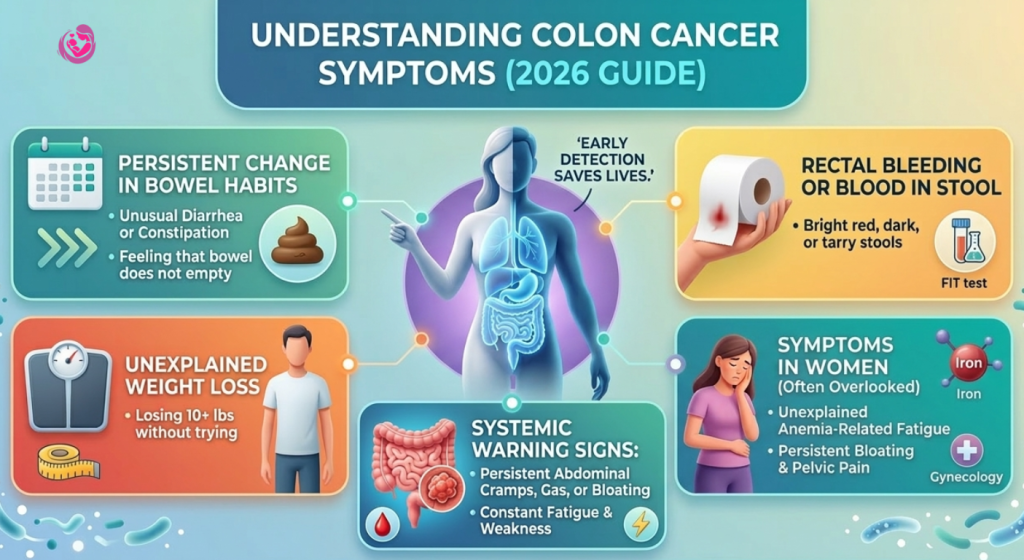
Detection of an indicator of colon cancer so that one is pro-active in health management is an important skill. One of the most common frequently observed signs is a sustained alteration in the bowel habit continuing beyond a few days e.g. diarrhoea, constipation or stool narrowing. Another notable symptom of colon cancer which can make the stool look dark, tarry or bright red is rectal bleeding or stool contains blood.
Besides digestive problems, a patient can be experiencing some systemic symptoms. Ten pounds and above reduction in weight without changes in food intake and physical exercise are critical signs of colon cancer. Persistent pain in abdomen such as cramps or gas which fails to fade should as well be evaluated. Given that the colon is involved in both absorption of water and the wastes, any tumorous growth that is going to interfere with these two functions will eventually translate to an external physical sign that all is not well.
Women and Colon Cancer Symptoms
It is not a disease of men as it is generally believed. In fact, the symptoms of colon cancer in women is one of the serious health problems in the USA. This can make women have tumours on the right hand side of the colon and this could slightly alter the symptoms. As an example, the right-sided tumour has higher chances to produce chronic bleeding, which is not visible at all but causes severe anaemia due to the lack of iron.
A woman can also feel abnormally weak or out of breath this is usually a common symptom of colon cancer in women but she can well mistake this with that of a heavy menstrual cycle or general fatigue due to a hectic lifestyle. Bloating and stomach pain can also be occasionally combined with a gynaecological issue such as a fibroid or endometriosis. Women must demand themselves and ensure that the developments occurring in their digestive tract or energy stores are investigated to be in either of the phases to trace the colon cancer, rather than having it termed as hormonal.
how to tell if you have colon cancer
To answer the question on how to determine whether you have colon cancer, the first one is that you need to cheque your risk factors and symptoms even though the second and most important is medical tests. You can not tell either by looking at your stool, or by the manner of your feeling. A physician is best able to determine the presence of the disease through a colonoscopy, in which he or she is able to see the entire lining of the colon and even excise the precancerous polyps on the spot.
The other and this is how to know whether you have colon cancer with the help of stool-based DNA tests which are rapidly becoming popular in USA among the average risk population. These examinations are after DNA abnormalities and blood that can be an indication of tumour. However, when any of the non-invasive tests are positive, the second procedure is always colonoscopy that will help in identifying one or other of colon cancer stages that possibly could exist. Due to the combination of genetic test and imaging, this procedure of the diagnosis is faster and more accurate than ever in 2026.
| Colon Cancer Stages | Clinical Description for Colon Cancer Stages |
| Stage 0 | This stage refers to abnormal or precancerous cells in colon polyps. It is also called “carcinoma in situ.” |
| Stage I | There’s a cancerous polyp in your colon wall. The tumor has grown into the submucosa or muscle layer but hasn’t spread further. |
| Stage IIA | Cancer has spread through most of your colon wall but hasn’t grown into the wall’s outer layer. |
| Stage IIB | Cancer has spread into the outer layer of your colon wall (serosa) or through the wall into the visceral peritoneum. |
| Stage IIC | Cancer has grown through the wall and is attached to or has grown into nearby organs. |
| Stage III | Cancer spreads to your colon wall, lymph nodes, or the outer layer of your colon. This is regional spread. |
| Stage IV | There’s cancer in other, more distant areas of your body, such as the liver, lungs, or ovaries. |
The journey through the various colon cancer stages is a marathon, not a sprint. With the advancements of 2026, the medical community has more tools than ever to ensure that a diagnosis is just the beginning of a successful treatment plan. Early action is the key to the best possible outcome.
FAQS
1.Can colon cancer be fully prevented?
Most cases can be prevented by removing polyps during a colonoscopy before they turn into any of the colon cancer stages.
2. Is Colon Cancer Stages 3 considered “advanced”?
It is considered “regionally advanced,” meaning it has moved to lymph nodes but hasn’t yet spread to distant organs.
3. What is the most common age for diagnosis?
While it most often affects those over 50, there has been a significant rise in diagnoses in people in their 20s and 30s in the USA.
4. How long does a colonoscopy take?
The procedure usually takes about 30 to 60 minutes, and with modern sedation, it is generally painless.
5. Does everyone with Colon Cancer Stages 4 colon cancer need chemotherapy?
Most do, but in 2026, many patients also receive targeted therapies or immunotherapy based on their tumor’s DNA.
6. Are Colon Cancer Stages 1 colon cancer symptoms always visible?
No, they are often completely invisible and only detectable through medical screening.
7. Is a family history a major risk factor?
Yes, having a first-degree relative with the disease significantly increases your risk.
8. Can a healthy diet lower the risk of progressing through colon cancer stages?
A high-fiber diet with low processed meat intake is proven to reduce the risk of developing tumors.
9. Is stage 4 colon cancer curable if it spreads to the liver?
If the spread is limited (oligometastatic), surgical removal of liver tumors can sometimes lead to a cure.
10. What should I do if I see a sign of colon cancer?
Do not wait. Consult a healthcare professional immediately to discuss a screening plan.
Leave a Reply