
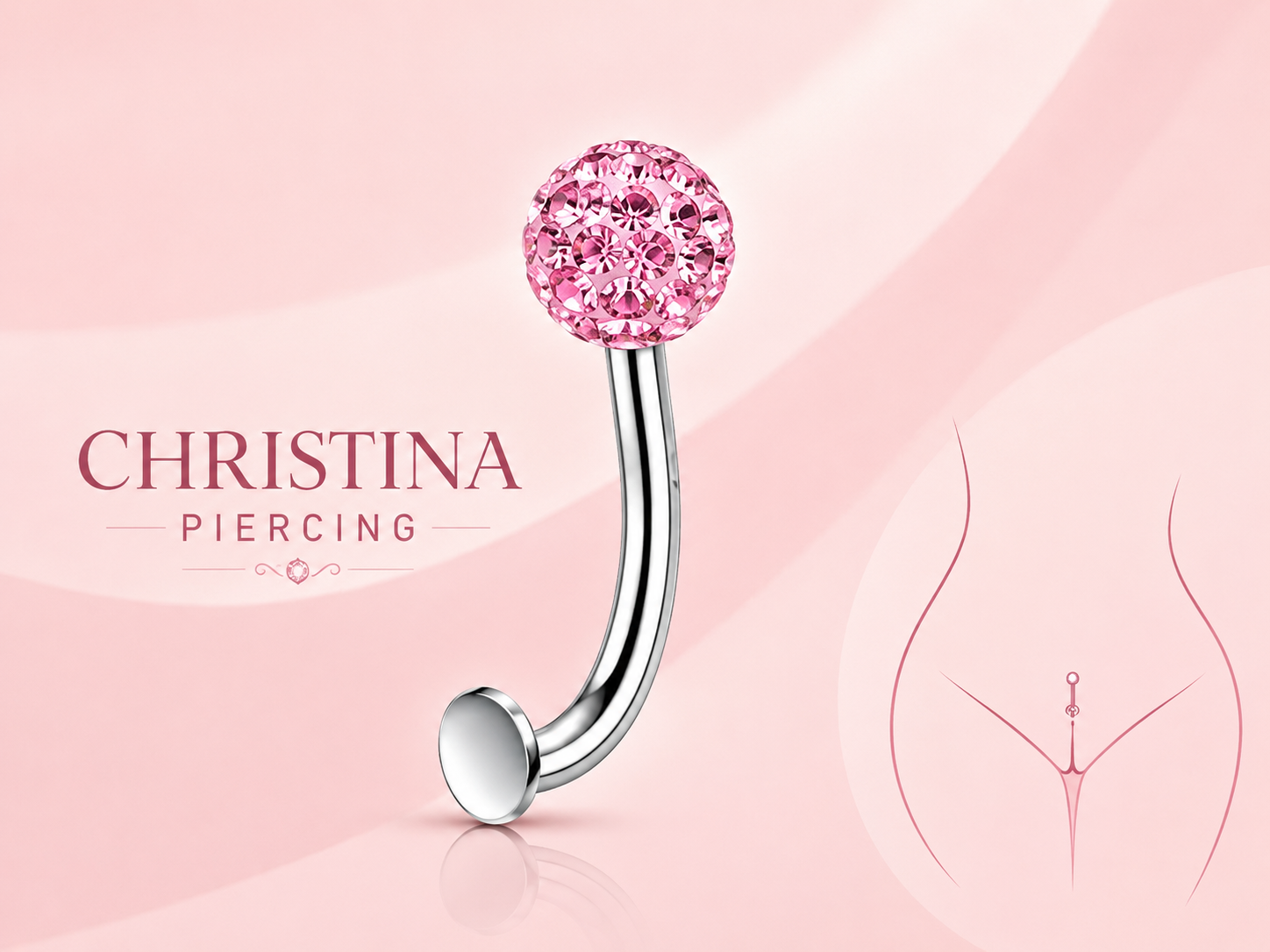
Christina Piercing: Pain, Healing, Cost, Aftercare, Risks & FAQs
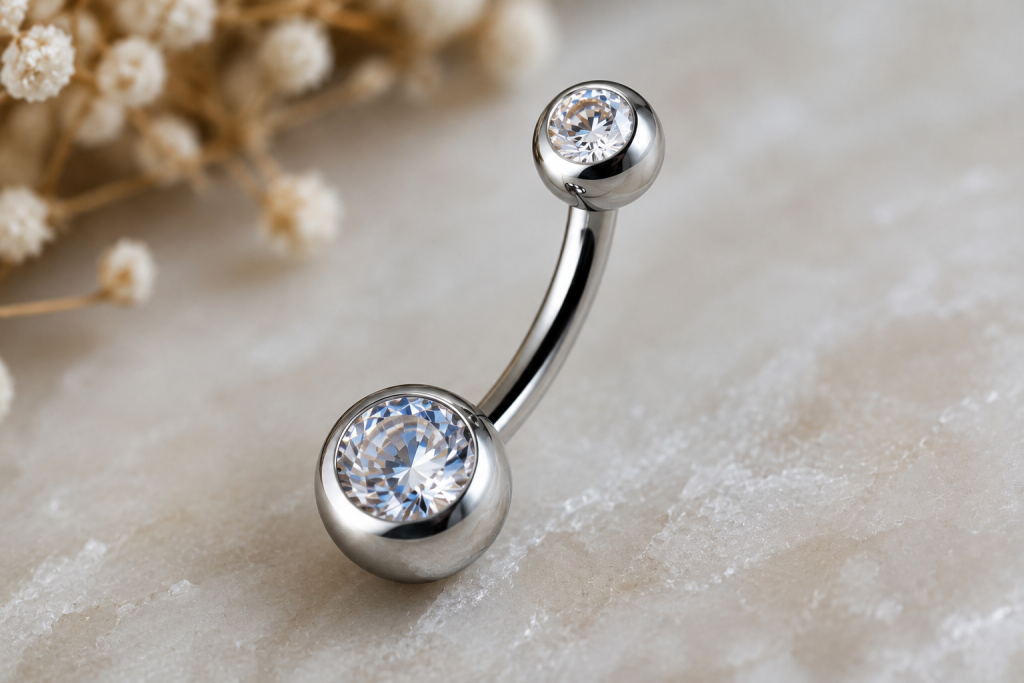
When you are thinking about a Christina piercing you will probably be looking for the truth — not fluffy information, or advice that was collected from someone else. Perhaps you’ve seen the amazing photos on social media, people have praised their photos, or you’ve read dozens of Reddit discussions with conflicting opinions.
One person states it hurts a little.One person states that it hurts very little. The other one describes it as their most painful piercing. For some, healing occurred easily, for others, there was irritation or rejection. What’s the real story?
The answer is that everyone’s unique, but there are facts to be considered that can help you determine if a Christina piercing is for you. It includes expert piercing information and the most frequently asked questions that are found online, so you know what to expect before, during and after the piercing.
No matter which country you are located in, whether the U.S., Canada, U.K., Australia or elsewhere in the world, the rules for safe piercing are the same: find an experienced piercer, educate yourself about your body, practice good aftercare and set realistic expectations.
What is Christina Piercing?
A female genital piercing known as a Christina piercing is a kind of decorative piercing inserted vertically on top of the vulva. It penetrates the tissue at the point of the outer labia meeting and leaves near the mons pubis, which makes it one of the most visually appealing intimate piercings.
A christina piercing is almost always done for its look and not as a way to enhance sexual sensation, unlike some other genital piercings.
Most people don’t experience extra sexual stimulation from wearing the jewelry as it’s not inserted in the sensitive tissue.
It’s a gorgeous option that many people love for body jewelry but prefer to have placed in an elegant way, something that isn’t as noticeable, and something that is very personal.
Are all of us good candidates?
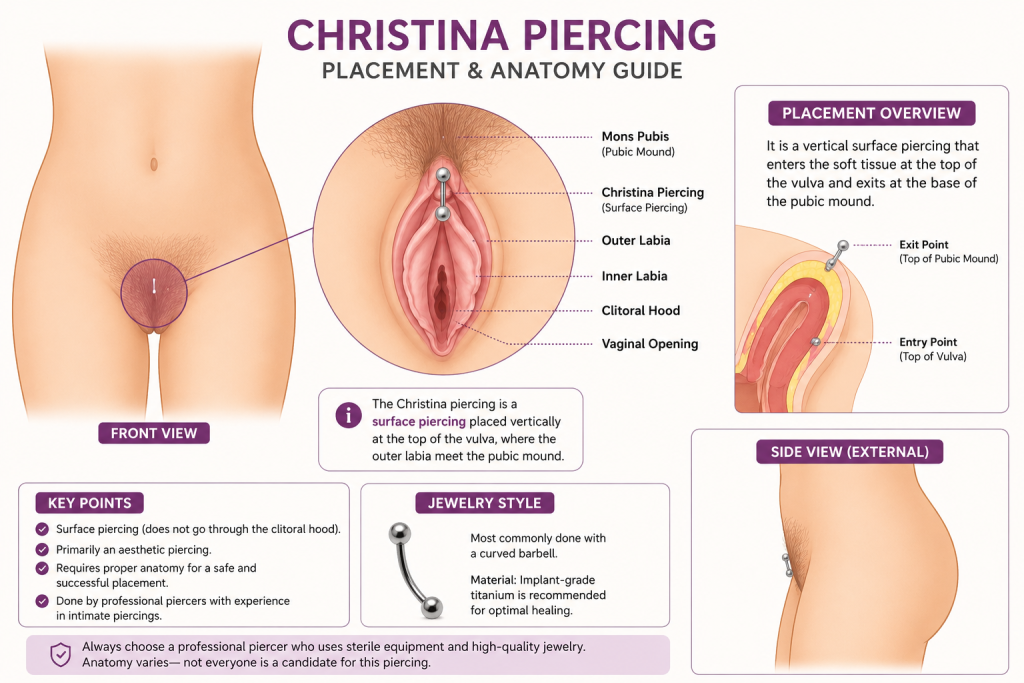
Some of the greatest misunderstandings is that anyone is capable of having a Christina piercing.
In fact, there is no more important consideration than anatomy.
The piercer will inspect the ridge of tissue running up the top of your vagina. Some individuals may have sufficient tissue to be able to wear the jewelry safely, and some just don’t have the anatomical structure for a successful piercing.
A good piercer will not do a procedure if your anatomy is not suitable, they will not attempt to “make it work.” This is a sign of service, not poor service.
Don’t force a piercer into a Christina piercing. A poorly positioned piercing will be more likely to rejection, migrate and scar.
What happens when you go for the procedure?
First-time wearers of intimate piercings are bound to be nervous.
Fortunately, the appointment in itself is relatively brief.
⦁ That’s what is generally observed:
⦁ A health questionnaire will be completed and medical history discussed.
⦁ The piercer will check your body to ensure you’re a good fit.
⦁ An antiseptic solution is professionally used for cleaning the area.
⦁ Placement marks are drawn, so you’ll be able to approve the location before anything happens.
⦁ The channel is made with a sterile, one-time use needle.
⦁ The jewelry is immediately inserted.
⦁ The piercer discusses how to care for the piercing after the procedure and answers last minute questions.
⦁ The whole piercing procedure takes about a few seconds, but the appointment takes 20-40 minutes.
How Painful Is a Christina Piercing?
The question of whether or not a Christina piercing causes pain is easily one of the most searched questions about a Christina piercing, but there isn’t a universal answer.
It’s usually a first stab of pain, and then a little burn in the area that’s gone in a few minutes. Others say that they experience moderate discomfort because the tissue is thicker elsewhere, such as in the earlobe.
It is considered an average body piercing by many experienced piercers.
There are several factors that will determine your own pain level:
⦁ Individual pain tolerance
⦁ Your anatomy
⦁ The piercer’s technique
⦁ Levels of stress and anxiety
⦁ Menstrual cycle timing
⦁ Previous piercing experience
Keep in mind that the hole that is put in the body is only lasting for a second. For the majority of clients, the wait is more painful than the actual process.
How much will a Christina Piercing cost?
The price depends on the country, city, the piercer’s experience and the type and quality of the jewelry used.
A good studio in North America might charge anywhere from $80-$180 USD for a christina piercing. Premium studios that offer implant grade jewellery or solid gold jewellery might ask for a higher price.
Avoid the cheapest studio as that may not be the best.
With regards to an intimate piercing, a lower price may indicate quality cutbacks in jewelry, sterilization procedures or professional experience, but none of these considerations are worth the risk.
When comparing prices, you should determine if they offer:
⦁ Implant-grade titanium jewelry
⦁ Sterile disposable needles
⦁ Consultation
⦁ Follow-up checkups
Decreasing appointments when necessary
The cheaper a piercing is, the more likely it is to get expensive if complications occur and medical treatment is necessary, or if the jewelry needs to be replaced.
The experience is more important than the price Why?
The piercing of Christina is not like an earlobe piercing, it needs a detailed knowledge of anatomy and surface piercings.
An experienced piercer will be able to assess the depth of the tissue, determine appropriate jewelry length, and place the piercing to minimize unnecessary tension that is likely to hamper healing.
Many people will go out of their way to see a piercer that specializes in the areas of intimate body piercing, which is why they’re willing to travel several hours, or even cross state or provincial lines, to see said piercer.
While it may seem that it is easier to go with the flow, picking skill over convenience is one of the smarter choices you can make, and this can make all the difference between a beautiful piercing and a frustrating experience.
Every week of the Christina Piercing Healing Timeline brings about different sensations and milestones.
One of the main factors which people worry about prior to getting a Christina piercing is healing. If you have looked at forum discussions, you’d have seen exactly the opposite experiences. Some have reported almost no irritation after healing, others for months and months, with difficulty.
The difference is frequently the result of three factors:
If the piercing is an appropriate fit for the individual’s body.
The skill of the piercer
The effectiveness of the after care routine followed
A Christina piercing is a surface piercing, unlike most piercings that are done in the ears or face. It takes longer to stabilize because it is located in tissue that moves, rubs and presses daily.
This is a realistic timeframe, although all bodies heal differently.
Week 1: Swelling & Tenderness.
The first couple of days will typically be the most uncomfortable. This is a very normal occurrence and should only involve mild swelling, redness, tenderness and sometimes spotting.
You may notice:
A little warmth surrounding the piercing
Lime or light yellow lymph fluid
Mild bruising
More sensitivity when standing or sitting.More sensitivity when standing or sitting.
This doesn’t necessarily indicate there’s a problem. It’s just your body’s own healing mechanism.
The most critical factor during this phase is not to touch unnecessarily. Each rotation, twirl and use of the jewelry introduces bacteria, and slows the healing process.
The “It Feels Better” Phase is from week 2-6.The “It Feels Better” Phase is weeks 2-6.
This is where many people make their biggest mistake.
The piercing is less painful, so it is easy to think that it’s healed. Actually, only its surface has begun to be restored.
Your body continues to create a healthy fistula (tunnel of tissue) around the jewelry inside.
In this stage you may experience:
1.Less redness
2. Minimal tenderness
3. Dried lymph, in small quantities.
4. Occasional itching
Actually, itching is one of the normal aspects of healing. Try to not scratch the area.
At months 2-6: Internal healing continues.At months 2-6: The inner healing process is ongoing.
Although your Christina piercing may appear to be healing well from the outside, it is healing on the inside, too.
Hence, it’s advisable to wait before making any changes to the jewelry or even stressful the piercing.
At this point many feel completely comfortable, however, comfort does not always equate to full healing.
How Long Does a Christina Piercing Take to Heal?
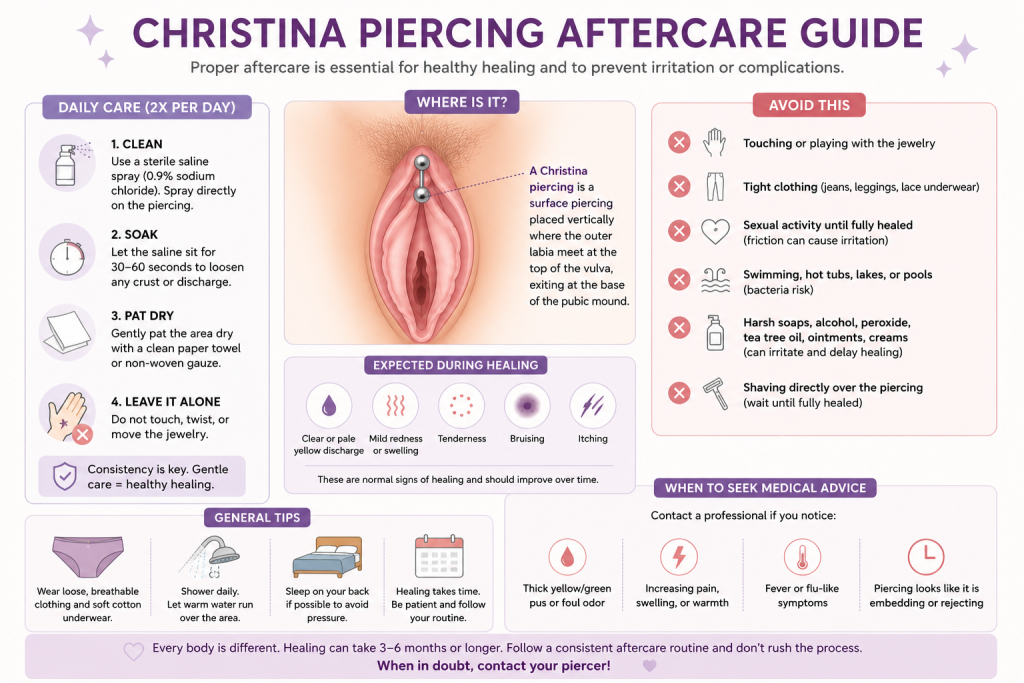
Most piercers will say that the healing process takes 3-6 months, and for some, a bit longer.
The healing process may be prolonged by:
⦁ Tight clothing
⦁ Frequent friction
⦁ Smoking or vaping
⦁ Poor nutrition
Type 1 or Type 2 diabetes, or other medical conditions.
Frequently looking at or touching the jewelry
Lying on the surface of the region
Instead of counting the number of weeks, pay attention to how your body feels.
Aftercare is the most crucial part of the entire process of getting a christina.Aftercare is the most essential after step of the whole christina getting procedure.
Some of the reasons why people are unable to heal is that they get too many opposing suggestions.
The best way to be safe is the easiest.
Wash away with soap and water twice a day.
Use sterile saline solution that is intended for wound care.
Pour a generous amount of sprays over the piercing, let them settle for 1-2 minutes, and pat the skin around the piercing dry with a clean patch of gauze or disposable paper.
If you can don’t use cotton balls as loose fibres can entangle in the jewellery.
Water is the best cleaner.Let water clean it.
Warm running water will naturally remove dried discharge when you have a shower.
Do not use excessive force while scrubbing the area.
Take the shower and gently pat the pearl instead of rubbing it with a towel.
Leave It Alone
An experienced piercer will say to you:
The less you do to it, the better it will heal.
Don’t rotate the jewelry.
Don’t twist it.
Don’t remove crusts by force.
Don’t constantly check it in the mirror every hour.
When your body is undisturbed, it heals best.
What is not to be done?
There are a number of daily habits that can hinder healing, without you even knowing.
Try to avoid:
Snug fitting pants in early weeks
Extremely tight jeans
When wearing lace, avoid getting it caught in jewelry.
⦁ Public pools
⦁ Hot tubs
⦁ Lakes and rivers
⦁ In early healing, long baths are recommended.
⦁ Harsh soaps
⦁ Alcohol-based cleansers
⦁ Hydrogen peroxide
⦁ Tea tree oil
Cosmetics (ointments, creams etc.) – except as directed by a healthcare practitioner
A variety of products, which are labeled as “piercing cleaners,” are too harsh.
Simple sterile saline is still the standard.
Is it Safe to Work Out After a Christina Piercing?
Yes—but, probably you’ll need to tweak your program for the first week or two.
High-impact activities can end up causing unnecessary conflict.
These aren’t comfortable for some people in the early healing periods:
⦁ Running
⦁ Cycling
⦁ Horseback riding
⦁ Spin classes
⦁ Heavy leg workouts
⦁ Contact sports
⦁ Walking is typically easier to do much faster.
⦁ Pay attention and listen to your body.
⦁ Pain is not to be “pushed through.
Is it OK to wear tight jeans?
This is a question that comes up a lot, as clothes do make a difference.
Loose-fitting clothes are the friend of the first few weeks.
Loose cotton underwear, air-permeable materials and loose pants will limit the constant pressure on the jewellery.
Many people move to a temporary:
⦁ Loose joggers
⦁ Athletic shorts
⦁ Cotton underwear
⦁ Dresses or skirtsana
After full healing of the Christina piercing, most wearers are able to resume normal clothing.
Can You Swim?
It’s best to wait until the piercing has significantly healed before swimming.
All microorganisms found in pools, lakes, oceans and hot tubs can cause infection when the piercing is an open wound.
Even really pure water is not sterile.
If you must swim, consult your piercer before you do so to determine the best way to do it.
Jewelry for Christina Piercing: What is the Best Option?
Many first time clients don’t understand the importance of jewelry quality.
The following materials are the safest:
Implant-grade titanium
High quality 14K or 18K gold for body piercing.
Niobium in some cases
Low-quality metals that make up mystery jewelry may irritate or trigger allergies, discolor, and cause slow healing.
An implant grade curved barbell made of titanium is the best option for the majority of individuals, due to its comfort, durability, and biocompatibility.
After your Christina piercing has completely healed, you can try some decorative ends, gemstones or gold jewelry if your anatomy permits.
Common Healing Mistakes that Cause Problems.
It’s not just that many complications are not caused by the piercing itself, but rather by well-intentioned mistakes.
These include some of the most common ones:
Putting jewelry on or taking it off too soon.
Over cleaning rather than regular cleaning.
Lying in close fitting clothes that rub the area.
Ignoring persistent irritation.
Going back to swimming prematurely.
Believing that a pierced part of the body is healed when it doesn’t hurt anymore.
It’s not a race to heal. It is often the case that the difference between a piercing lasting for years or months is whether the body is given enough time.
Here are some questions to ask before getting a Christina piercing:
As with any piercing, it’s crucial to select the right piercer as well as the right location. A professional consultation allows you to learn if you are a good fit as well as if the studio utilizes safe techniques. Be not afraid of asking questions, a good piercer will answer.
Here are some of the most important questions to ask during your consultation:
Am I a good fit for a Christina piercing?
Not all people can have this type of hole in their ear. An experienced piercer should be a real piercer and not attempt to make every client fit.
- How many times have you performed Christina?
Experience matters. Some piercings are easier to perform than others, but intimate piercings are a specialty that demands knowledge and skill. - What jewellery element do you suggest?
It is widely believed that implant grade titanium is one of the safest materials to start with for jewelry due to its light weight, durability and high biocompatibility. - Do you have all of your equipment that is sterile?
All equipment should be sterile, needles are to be used only once, clean gloves should be worn, and the setting should be sterile and professional. - What if my piercing doesn’t heal as I’d like?
A trustworthy piercing shop will also discuss their after-piercing care and if they provide free post-insertion exams if you have questions. - When should I take medical advice?
It is important to be able to tell the difference between normal healing and possible issues so you can take appropriate action when you have concerns. - Will I be able to reach you for questions following my appointment?
A large number of professional studios will want to contact their clients when they have reservations as healing continues.
I will list the risks that may apply to my anatomy.
All people are different. The consultation must be personalized as opposed to a lecture. - How long can I wait before changing my jewellery?
If the piercing looks like it has healed, don’t change the jewelry too early, as this can cause irritation. Your piercer should let you know when this is the best time. - Have you fixed up the photos of your portfolio?
Reviewing pictures of healed piercings (not just those just taken) can provide a good indication of the piercer’s experience and reliability.
Discover the truth behind the myths and misconceptions about christina piercing.
More than some piercings, there is a lot of misinformation around intimate piercings because they are not talked about as openly as ear and nose piercings. Let’s clear up fact from fiction.
Fact: A Christina piercing is not a VCH piercing.
Fact: They’re totally different piercings!
The main difference between a Christina piercing and a VCH (Vertical Clitoral Hood) piercing is that the former is decorative and goes above the clitoral hood, while the latter goes through the clitoral hood and could be more stimulating to some.
The myth is that anyone can have a Christina piercing.The myth is that anyone can have a Christina piercing.
Fact: If you are not an adequate candidate for the job, anatomy will tell.
If a qualified piercer tells you not to have it done because your anatomy isn’t conducive to it, they are not providing poor services—they are being professional!
Myth: When it comes to healing, more cleanliness is better.
Fact: Over-cleaning can cause skin irritation.
Generally, it is better to stick to your piercer’s cleaning and care plan than it is to continually use various products and clean.
Myth: Expensive jewelry is all about looks.
The fact is that good quality jewelry can have a significant impact.
The materials used for body piercing are made to high standards and are less apt to cause irritation than poor quality metals.
Myth: It doesn’t hurt anymore, so it’s healed.
The truth is that the less painful, the less healed.
It’s possible that healing is still going on under the surface even after the piercing is comfortable to wear.
Myth: A Christina piercing will lead to greater sexual gratification.
Fact: It is most often selected because of its appearance.
It’s not always a sensation-enhancing piece of jewelry but is more commonly regarded as an aesthetic piercing.
Fact: Not all piercers do intimate piercings.Myth: Piercers always do intimate piercings.
Fact: Not many studios do.
When you want to have a Christina piercing, you need to find a piercer who has a good experience in doing these kinds of piercings.
Should you get a Christina Piercing?
Many people answer yes, but provided their expectations are realistic.
Many people opt for a Christina piercing as a way to express themselves, to boost their body confidence or to add a touch of their personal style. Many people enjoy that it is a private piece of jewellery that has significance, but that isn’t in plain sight for everyone.
On the other hand, it’s crucial to realize that this piercing takes time. Healing may take months, anatomy is a very important part of success or not every body is suited for it.
When looking into Christina piercings, do a thorough research, select an experienced piercer and ask a lot of questions in your consultation. The best way to make sure that you are happy with the result is to make an informed decision.
At the end of the day, the best piercing is the one that is right for you, your lifestyle and your goals; not one that’s popular on social media | discharge orange color
FAQS
- Does a Christina piercing hurt?
Most people describe the procedure as brief, with pain levels varying depending on individual tolerance and anatomy. - How long does a Christina piercing take to heal?
Healing varies from person to person and should be assessed by an experienced piercer during follow-up visits. - Is a Christina piercing only for aesthetics?
Yes. Unlike some other intimate piercings, it’s generally chosen for its decorative appearance rather than increased sensation. - Can everyone get a Christina piercing?
No. Suitable anatomy is one of the most important requirements, which is why a consultation is essential. - Will it leave a scar if I remove it?
Like most piercings, some degree of scarring is possible, although its appearance varies from person to person. - What type of jewelry is commonly used?
Professional piercers often recommend implant-grade materials specifically designed for body jewelry. - How much does a Christina piercing usually cost?
Pricing varies depending on your location, the studio, the piercer’s experience, and the jewelry you choose. - How do I know if a piercing studio is reputable?
Look for cleanliness, proper sterilization practices, quality jewelry, positive reviews, transparent communication, and a piercer who prioritizes your anatomy over making a sale. - Can a Christina piercing be removed?
Yes. If you decide it’s no longer right for you, a professional can advise on safe removal and what to expect afterward. - Is a Christina piercing worth getting?
If your anatomy is suitable and you appreciate it for its aesthetic value, many people find it to be a rewarding form of self-expression. The key is making an informed decision and choosing an experienced professional.
Finel Thoughts
Christina piercing is among the most unique intimate piercings on offer, which is both elegant and individualistic. It may not be suitable for everyone, but if you do know how it’s done, how to pick a qualified professional and what to expect, you’ll be able to determine if it’s a good fit for your goals.
Take your time, ask questions and look for the expert. When you make an informed decision now, it is likely you will experience a much more satisfying experience in the long run.
Leave a Reply