
Info about baby learning building Curiosity
From the first eye contact to the little sound, it doesn’t matter if it’s a soft coo; every action is a sign of communication or a way of saying I need you. It is important to understand the behavior of anewborn Parents ask when do baby learning starts, including when baby learning starts from clapping, languages, talking, crawling, smiling, and many more. When you understand baby behavior and try for baby learning it builds a strong connection. Their behavior itself tells what is needed. Understanding the behavior of a newborn can be difficult for a new mother, but there is no problem that can let alone baby learning together.
Security or connection
The first moment of eye contact is not just a small act; it is a way of saying Keep me safe I trust you. They look to you for security and comfort. Every small action, like a look or a sound, is a way of building a strong connection and bond. Remember that they are only dependent on their caregivers. They want love, attention, a loving presence, and gentle handling. Always respond to them with kindness or facial expressions. Meet their physical or emotional needs Every baby’s behavior is unique. Some are noisy, sensitive, and active. The more time you spend with your newborn, the more you will learn their behavior and they will develop a sense of self confidence
First love language
Your baby starts baby learning or feels comfortable or shows interest.
• Eye contact
• Laughing or smiling
They relax when they hear your voice.
How to respond?
• Hold your baby with a smiling face and make eye contact.
• Talk to them softly or sing to them in a soft voice.
• Skin-to-skin contact, especially during feeding
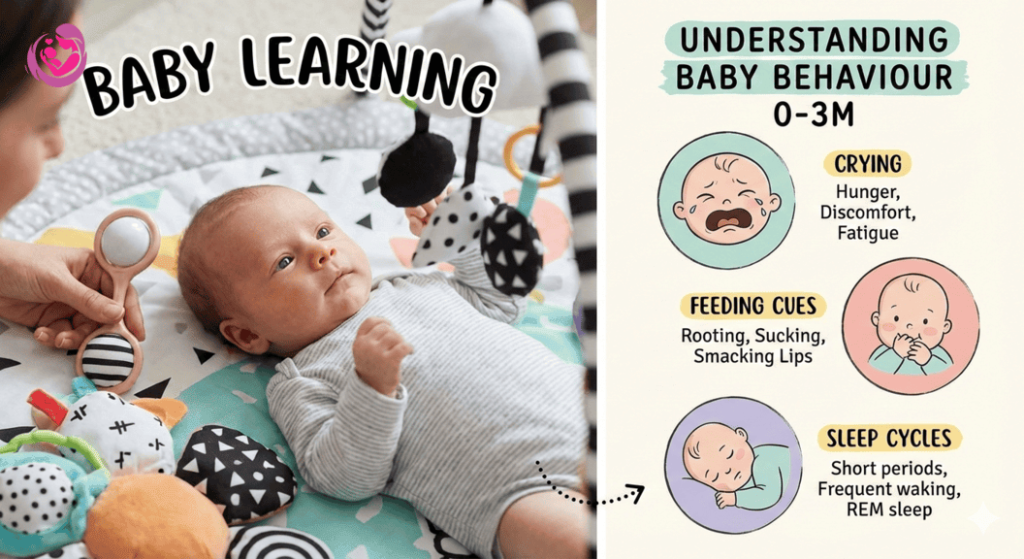
Behavior behind crying
If a baby is crying, they need your attention or they want to communicate or you are there for them for. Here are some common reasons.
Physical need
• Sleep: If they are not comfortable, a baby may have trouble sleeping or cry out in pain.
Hunger: If the baby is hungry, especially a 2-3-month-old or hasn’t fed in 3 hours, he will definitely cry.
• Pain: If the baby has a dirty or wet diaper or a tight dressing, is too hot or overstimulated
• Illness: If the baby has an infection or stomachache, they will definitely cry.
• Burp: If you don’t burp, the baby will vomit or feel pain.
Emotional needs
• If they are scared.
• Loneliness keeps them holding or walking outside.
• Swinging or hugging
• Too much noise
• Wants closeness or skin-to-skin contact.
A normal baby cries for 1 to 3 hours a day. Or 5 hours, especially in the first 3 months. The crying becomes more frequent or gets worse. If your baby’s crying is excessive or persistent, seek medical help.
| Baby’s Action | baby learning | What it Usually Means (The Cue) | Recommended Action |
| Rooting/Sucking Hands | “I am hungry.” | Feed immediately before they cry. |
| Turning Head Away | “I am overstimulated/tired.” | Reduce noise, dim lights, give space. |
| Arching Back | “I am uncomfortable or have reflux.” | Burp the baby or change position. |
| Rhythmic Cooing | “I am ready to learn/play.” | Engage in eye contact and talk to them. |
| Jerky Arm Movements | “I am startled or overtired.” | Swaddle them for security. |
The Behavior Behind Sleep
Newborns sleep in short bursts. They usually sleep for 2 to 4 hours because their stomachs are small and they need to be fed regularly at 2 or 3-hour intervals.
An average baby needs 14 to 17 hours of sleep in a 24-hour period. They may sleep more than 6 hours after 6 months, but even 6 hours of sleep at night is unusual in a newborn. This is an indication of developing sleep patterns. Most newborns do not sleep for 6 hours. If your newborn sleeps too much or sleeps for too long, he may have a problem with weight loss. Consult a healthcare provider for help.
Healthy Sleep Habits
• Do not force your baby to sleep, so that the baby learning starts itself and follows its own sleep pattern.
The environment should be calm, safe, and appropriate, especially at night. He will fall asleep easily.
• Do not use a mattress on top of a pillow; always use a blanket on a flat surface.
• Snuggle them or gently rub their back after feeding.
• These preferences change over time as they grow,start baby learning or their behavior changes.
• Make sure to place them on their back
Feeding Behavior
Breastfeeding is a very important process through which you provide your baby learning with all the nutrients they need, simply by making eye contact or providing warmth during feeding, and by strengthening and securing your bond with your baby. It does not matter whether you bottle-feed or breastfeed. In the early weeks, most babies need to be fed every 2 to 4 hours during the day. They will eat less at night than during the day.
Signs of hunger
• Observe their hand or head movements such as rooting or rocking. They will try to turn their head towards your chest or hands.
• They suck their hands or bring their hands close to their mouth or suck their lips.
• They increase their activity to look with open eyes.
They may spread their legs or arms to point to their middle finger.
Crying is the ultimate sign of late feeding but it can also be a sign of other discomfort.
Things not to do?
I. Never force a baby to breastfeed or give too much milk.
II Do not use formula milk with too much water.
III Do not use any food that is high in sugar, salt or sodium. Do not introduce solids too early.
IV Do not support the bottle as this can increase the risk of ear infections or tooth decay.
V. Do not microwave the bottle.
Newborn Curiosity and baby learning Behavior
• baby learning starts from their first day through active exploration. baby learning begins through sounds, visual facial expressions, responding, touching or smelling.
Infant cannot see clearly. baby learning starts from moving objects, but are 8 to 12 inches blurry. Or can see black and white colors.
• They use expressions or make sounds to get the attention of others.
• They suck their fingers, toes and look at textures.
• They discover new things on their own.
• They observe every action that you repeat, such as singing.
• They recognize their meal times.
• A 2 to 3-month-old baby learning shows their interest or excitement towards objects.
Encourage to baby learning
• Offer them colorful or high-contrast books and textured toys
• Respond to their smiles, sounds, and coos. it encourages baby learning. This will connect you with your baby and create a powerful connection.
• Sing to them. They will happily observe.
When to see a doctor?
If the baby is not eating well or losing weight.
Or if they sleep late or are difficult to wake up.
Or if they cry or are not calm, if they cry a lot, play.
Or pay close attention to whether they have chest sounds, fever, and difficulty breathing.
As a mom, I learn that Parents are a beautiful discovery between you and your baby learning Understand them, be patient, it will take time for baby learning behavior, especially if you are a first-time mother. A small act of love and care goes a long way. The health of the baby is closely related to the health of the mother. If you are healthy, the baby will also be healthy.
Conclusion
Fiat in Process et in Instincts.
The twelve-week baby life, when it is commonly referred to as the fourth trimester of the pregnancy, is not like time-keep, it is more of an emotional time-keep. Although it is irritating to fake the night screamings and the mystery of the so-called witching hour, keep in mind that any communication will be a brick to your future child.
Through active observation you not only pass through the day but you also train your baby that the voice of the latter is not nothing and the world is a nice place to be in. This art of reading these early behaviours which are so imperceptible to notice at the very best, and how to cause them to turn their head when they are overworked, or to get their head into the smile, is the power to start a lifetime conversation.
Parenting is not a 5 minute race, it is a long distance race. Inhale and comprehend that in the insecure times that you are the sole item that your child is to grasp and develop. You do not have to be an ideal parent, you simply need to be a working parent.
FAQS
1.Why do I cry at night because my baby does not have any reason?
This is what is called the Witching Hour. The baby is easily bombarded with the day sights and sounds in the first three months as the baby learning and struggles with the nervous system. There is no reason but it is their means of getting rid of over stimulation. The best active treatment is mild rocking or dark and silent room.
2.Could the infant who is 0-3 months old learn anything?
Absolutely. They are being taught Trust, though not the ABCs. The connexion in their brain creates, whenever you respond to their cry, and that states the world is a safe place. It is against this background that, all future baby learning is grounded.
3.What does the passionate glare of my baby upon my face entail?
The visual range of infants is 20-30cm between your face and that of your infant- the gap between you and your infant when you are feeding it. They are charting out your features, as they gaze, to understand how to read the moods of human beings. It is their first lesson on social interaction.
4.Should Tummy Time be present during the first month?
Yes, but keep it short! Tummy time does not only concern physical fitness but also changes the perception that the baby has towards the world. It helps in developing of the neck muscles needed in making visual tracking that is one of the elements of the early cognitive development.
5.Then why is my baby screaming in his or her sleep?
This is the Moro Reflex. To survive is a natural survival instinct. The information on this behaviour will enable the parents to realise that the baby is not experiencing a nightmare, but it is merely a normal process of adjusting the body to the life outside the womb. In some cases swaddling will help them to feel secure.
6.Why do I mean by the difference between a cry of hunger and a cry of weariness?
As the active parenting begins, observation is brought. Hunger cry is most frequently rhythmic and insistent and usually significantly preceded by rooting (finding the breast or the bottle). A weary wail is more of whimpering or a discontinuous wail, and invariably is accompanied by scratching the eyes or drawing up of the ears.
7.And will the fact that I will be talking to my newborn baby help their brains at all?
Yes! They do not know words but, using so-called parentese that is rhythm and tone of your voice, language centres of the brain are triggered. Telling your day -Now Mummy is bringing tea- is brain food of the 2 month old.
8.Why is my 2 months old baby very restless?
Infants are not yet capable of synthesising Melatonin (the sleep hormone) yet. They rely on your cues. The parents should know that their Circadian Rhythm is not fully developed yet, that is why, they should be patient whenever 3 AM wake- up call occurs.
- 9.What then are Engagement Cues and disengagement Cues?
A baby “talks” with their body. - Tactile Wide eyes, outstretching, cooing.
- Disengagement: shaking of head, arching of back or yawning.
Advanced active parenting a skill is being able to know when your baby needs to take a break.
10.And shall I be baby-spoiler by baby-holding?
Science says: No. When one is at the 0-3 months level, a baby cannot be spoiled. The opposite sex (Skin-to-Skin) contact regulates their pulse and reduces cortisol (stress hormone). Their incarceration results in them being more aggressive and secure in their future.
Leave a Reply