

The six months mark can be the end of the road to a fair number of parents. You have gotten out of the haze of newborn, you have already surpassed the 4-month transition that is infamous and you may be even enjoying those elusive day through sleep intervals. Then all at once, the crying returns. The midnight parties begin. You are now left wondering whether there is a 6 month sleep regression or have we just lost all our gains?
A 6 months sleep regression in sleep is one of the most misconceived infancy phases. Unlike the 4-month regression, which is an irrevocable biological alteration of sleep structure, the 6-month disruption is usually a classical perfect storm of physiological milestones, diet change, and intellectual progress.
In this case, the science of 6 months sleep regression patterns will be disaggregated, the indicators will be singled out and action plans can be offered to fix your situation of not sleeping in your house.
1.what is Sleep Regression
To understand the details of the issue concerning a six-month-old child, we must answer the question of what the notion of the sleep regression means in the first place. A regression in regard to pediatric sleep can be defined as a period in the life of the baby (usually 2-6 weeks) when the baby starts losing his or her routine sleep pattern significantly.
The Paradox of 6 months sleep regression
Remarkably, most of the professionals prefer the term progression. Why? Sleep does not hold together whereby the brain is overworking. It might be the months of sleep regression 4, 8 and 12, but they have one thing in common, namely, sleep regression is almost always followed by an immense developmental leap. The baby is not regressing, the baby is simply too busy learning to be a human being that at night it loses the ability to turn off its brain.
Any regression can be described as having common features as:
- Increased night awakening rate.
- The protest against naps that were not complicated.
- Unreasonable fussiness on waking up.
- Changes in appetite.
Sleep Regression 6 Months
The 6 months sleep regression period stands out because it is an age that experienced a colossal change in the life of a baby. The half a year old world is proving to be a very exciting place.
The variance between the 6-Month Mark.
The four month regression in regards to sleep cycles ( between the newborn sleep cycles to the adult-like REM/NREM sleep phases) occurs. The regression around the capability is the six-month regression.
This is the age of “firsts”:
The lining of real food may be provisional with the digestion and internal rhythms.
First Teeth: The first pearly whites begin to emerge at this age to a large number of people.
First Independence: Infants are starting to realise that they are not the same people (the formation of object permanence)
Do you ask, is there a 6 month sleeping regression? the answer is a yes and no. Even the babies are not all as disturbing as the 4 months mark, the convergence of the physical and mental growth causes the regression of the sleep of the 6 months sleep regression old which is a verifiable phenomenon.
Sleep Regression Months
Even though we are talking about the 6-month mark that we can consider the larger time frame of sleep regression months to see where this would fit in. The big picture will help parents to realize that such are transitional phases that will be foreseeable.
| Age Milestone | Difficulty Level | Primary Cause | Typical Duration |
| 4 Months | High | Permanent Sleep Cycle Maturity | 2–4 Weeks |
| 6 Months | Moderate | Milestones (Sitting/Rolling) & Solids | 1–3 Weeks |
| 8-10 Months | High | Crawling & Separation Anxiety | 3–6 Weeks |
| 12 Months | Moderate | Walking & Nap Transitions | 2–4 Weeks |
By regressing the ages of the sleep in this way, you will manage to establish your environment, and your attitude to the further changes.
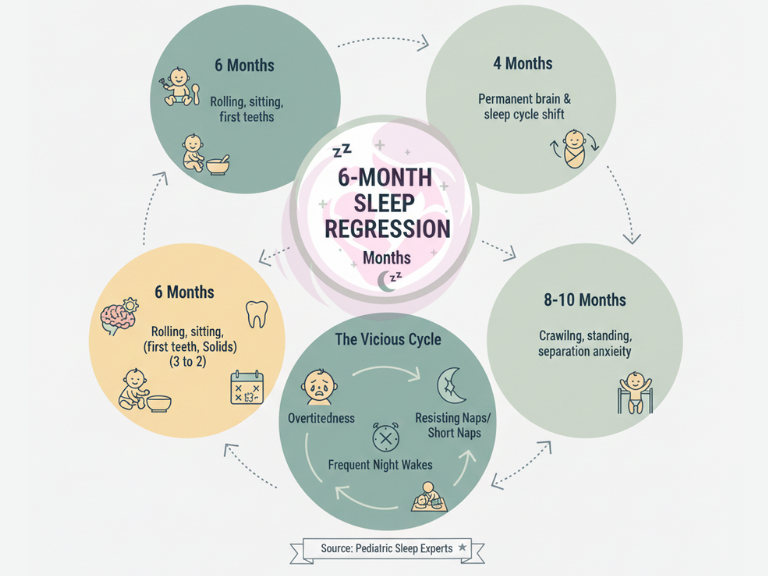
Sleep Regression Ages
Why do people appear to be subject to sleep breakage at certain regression ages of sleep? It is cut down to Biological Sleep Pressure and Circadian Rhythms.
6 months sleep regression the inner clock (circadian rhythm) of the infant is more strong. The need to sleep or the need to sleep that builds up when they are awake is changing as well. The infants also have the ability to maintain more awakening (2-3 hours) and in case the parent is unable to re-establish the schedule so that the new awakening the child is experiencing is achieved, the children become over tired.
The feeling of being overworked causes an adrenaline rush and cortisol. This makes it extremely difficult to fall asleep, as well as maintain the sleep, of a baby resulting in the much feared 6 months sleep regression type of symptoms
Sleep Relapse of 6 Months Symptoms
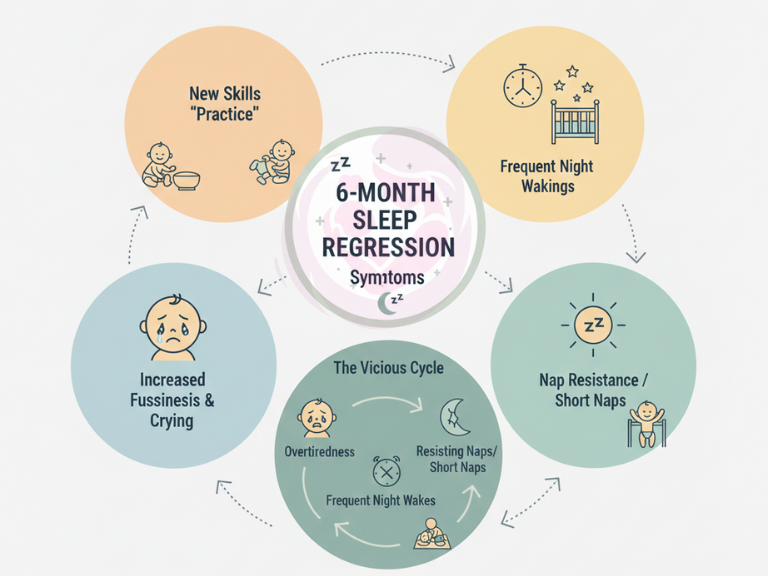
What would you know about a 6 months sleep regression or you are just having a bad night? Name a list of such symptoms of 6 months sleep regression old sleeping regression:
Frequent Night Waking
When your baby was accomplishing a 6 hours increment and your baby all of a sudden jumps to every 2 hours then this is the tipping point. They are not often lifting their heads as they are starving but preparing their talent in the sleep.
The “Practice” Effect
It is not surprising that you cheque the monitor at 2:00 AM and realise that your baby was sitting or rolling somewhere in the crib. Their brains are intertwined to the extent they have mastered these motor skills that they do this unconsciously when in light sleep.
Nap Resistance and Short Naps.
At the sleep 6 months sleep regression stage the so-called “crap nap” (nap that takes between 30 to 45 minutes) begins to recur. They can be poor at the beginning of the nap, or in crying in the middle of the day.
Making Separation Anxiety Worse.
Object permanence starts to be developed in infants at approximately 6 months. Now that you walk out the room they know that you are somewhere. This may make them weep hysterically as soon as you place them in the crib.
Drastic Change in Mood
The loss of night sleep has the result of rendering infant other-wise tempered, irritable, and hard to wipe away on a day to come, just because of summative exhaustion.
| Symptom | Is it the 6 months sleep regression? | Possible Alternative Cause |
| Frequent Night Waking | YES (Brain is overactive) | Hunger or Cold Room |
| Crying when put down | YES (Separation Anxiety) | Ear Infection (check for fever) |
| Short 30-min naps | YES (Transitioning nap needs) | Room is too bright |
| Chewing on hands | Likely No | Teething |
| Refusing the 3rd nap | YES (Ready for 2-nap schedule) | Overtiredness |
Elizabeth and Darcy on How to make sleeping regressions in your baby
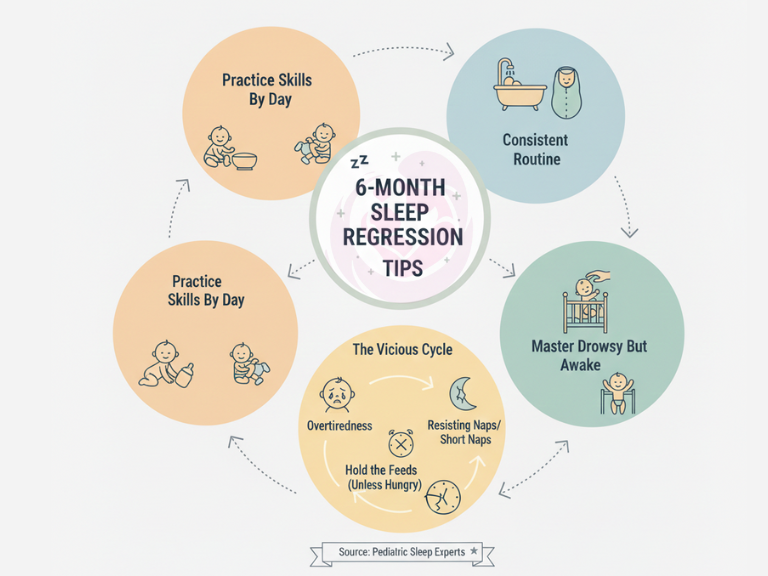
More specifically, the balance in negotiation should be with consistency and grace throughout old 6 months sleep regression. The measures that sleep consultants apply across the globe are the following:
A. Optimize the “Wake Windows”
The mean infant sleep at the age of 6 months sleep regression is 2.25-3.0 hours of day in between sleep. In case your baby still adheres to the 4-month schedule (1.5 to 2 hours), then he or she will not be so sleepy to fall asleep and will end up making frustrating short naps.
B. The Bedtime Routine with The Levelled Ups.
Consistency is your anchor. This requires a child of 6 months sleep regression to have some clear messages reminding them that the working day is over.
Bath: This is administered to reduce the core body temperature.
Massage/Lotion: Gives the touch senses.
Reading: Slows down the heart rate and concentration.
Sleep Sack: Swaddle (when rolled) needs to be changed, and it is not safe.
C. Learn How to apply Drowsy-But-Awake Technique.
Your baby will not do well in the 6 month sleep regression in case he or she will be either rocking at the time or feeding to sleep to full. The next time that they fall asleep during the sleep intervals at 2:00 AM, they will insist on the same prop (the rocking or the bottle) in order to fall asleep again. When they are 90 per cent asleep, yet they know of the crib, make efforts to put them into the crib.
D. Wallplay with the Preoccupied Eater.
Infants have been reported to be distracted at the age of six months. They will slice the breast or the bottle such that they can glimpse a lamp or a dog that is yelling. This leaves them snacking through the day and reverse cycling (eating most of their calories at night). Eat in a dim room where they can have all their meals of the day.
E. Practice New Skills by Day
To eliminate the sitting-up sessions at 2:00 AM, provide your child with a lot of floor time throughout the day. Roll them, get them to sit and scoot till they are physically exhausted. The less they will do it at night they will think they should do it during the day.
Sleep regression Timeline
| Time Block | Activity | Expert “Premium” Tip |
| 7:00 AM | Wake & Milk | Open blinds immediately to set the body clock. |
| 9:15 AM | Nap 1 | Aim for a 2.25-hour wake window here. |
| 10:45 AM | Mid-Day Activity | High-energy floor play to exhaust motor skills. |
| 1:30 PM | Nap 2 | The “restorative” nap; keep the room pitch black. |
| 3:00 PM | Afternoon Milk | Ensure a full feed so they don’t wake hungry at night. |
| 4:30 PM | Optional Catnap | Keep this to 20 mins max if they are very fussy. |
| 6:30 PM | Bedtime Routine | No screens; focus on calming touch/massage. |
| 7:00 PM | Bedtime | Place down “Drowsy but Awake” to build skill. |
The Objects persist: Cognitive development
This is the “Where did Mommy go?” phase. The first thing he is acquainted with is that the baby is personality. It is extremely dreadful and exciting that they are in mid-night most of the cases up and merely probing whether you have eluded or not.
Biological Maturation
They have swollen out their stomachs, altered the body metabolism by the intake of the solids and disoriented the sleeping habits. We use the word regression, but it is an expression that we possess a good and healthy nervous system.
(FAQs)
1.What is the number of months of 6 month sleep regression?
Its usual span is between 2 and 4 weeks. When the disruption is longer than 6 weeks, it might be possible that the association with the sleep has occurred (eg. the necessity to be rocked) but not the 6 months sleep regression.
2.Can sleep training be induced to counter 6 months sleep regression?
Yes! According to the observations of the majority of specialists, the golden number of sleep training should be 6 months sleep regression because a baby is now better than qualified to be able to self-comfort, though, he/she is not a strong-willed child as a toddler.
3.Why does my six months old child wake up after every hour?
This is normally due to the fact that they are too tired or due to teeting. Examine the gums, and see that the infant is not overstimulating himself between the second and the third nap.
4.6 months sleep regression necessary in teeting?
Teeting brings sleep disturbance that is more of a similarity of a 6 months sleep regression. The distraction will cause one-week instability in a schedule, unlike a tooth that will just be likely to cause acute pain within 23 days.
5.In this 6 months sleep regression would I feed my baby each time they wake up?
The 6 months sleep regression of age babies will not be required to be fed at a two hour interval except when their pediatrics insist they have attained a healthy weight. Other forms of comfort measures should be tried in place of establishing a feeding to sleep habit.
6.Is there no reason why the solids should not be introduced, in such a way that a baby may sleep at night?
When a bottle is introduced with solid or contains cereal, this is not necessarily the solution to falling sleep better as the ancient myth presupposes. Actually, in certain situations, the new digestive may cause the generation of further gas and the alertness of some babies in the beginning.
7.The number of naps taken by a 6-month- old?
The majority of the 6 months sleep regression olds are currently changing their 3 naps into 2 naps. The need to raise the wake window is also another typical symptom expressed in the third nap resistance.
8.Why does my baby cry immediately I put him/her in crib?
This will probably be separation anxiety. Spend more time with them playing in their nursery during the day so as to make the room a happy safe place instead of a room of separation.
9.Is the 6 month regression the worst compared to the 4 month regression?
The 4-month regression is more difficult to make in the majority of cases since it is irreversible change. The 6 months sleep regression regression is quite more of a stretch of milestones and teething that will be forgotten as soon as the skill is acquired.
10.When should the doctor visit the child?
To ensure that your baby has no fever, is not ready to eat at all, or that the alteration of sleep systems is accompanied with signs of some disease (pulling of the ear, cough or feeling of overwhelming fatigue): check with your doctor as he may rule out the chance of ear infection.
Leave a Reply