

What are the most common sleep regression ages

It occurs in the twinkle of the eye. The night is here and you are finally sleeping six hours without getting disturbed by anything. You even find yourself waking up again as a human being and your coffee in your hand and a winner. Then, the sun sets. Then the following moment you listen to your good sleeper screaming when his or her back touches the mattress. They are rollling cribs and thrashing gymnasts. You check the diaper, the temperature, the bottle– okay, but not one of them is asleep.
His enticement to the realm of sleep regression ages
Sleep is the gold of the world to parents in the USA and most of the globe. And you will have difficulty when it is lost. In this case, however, has the secret of the “premium” been lost which is one most parents who have just come through a sleepless night have; that a slip back does not mean that something is wrong; it means that something is very, very right. It is a biological by-product of a gigantic software update of the brain. The baby which you are carrying is busy with the process of connecting the new things, acquiring the motor skill and becoming conscious.
This will be demystified in this guide, and we are going to give you a road map to the most popular sleep regression ages the sleep regression ages milestones which cause it, and how we can not only live through this without a hammer to shatter your rhythms that you so carefully constructed.
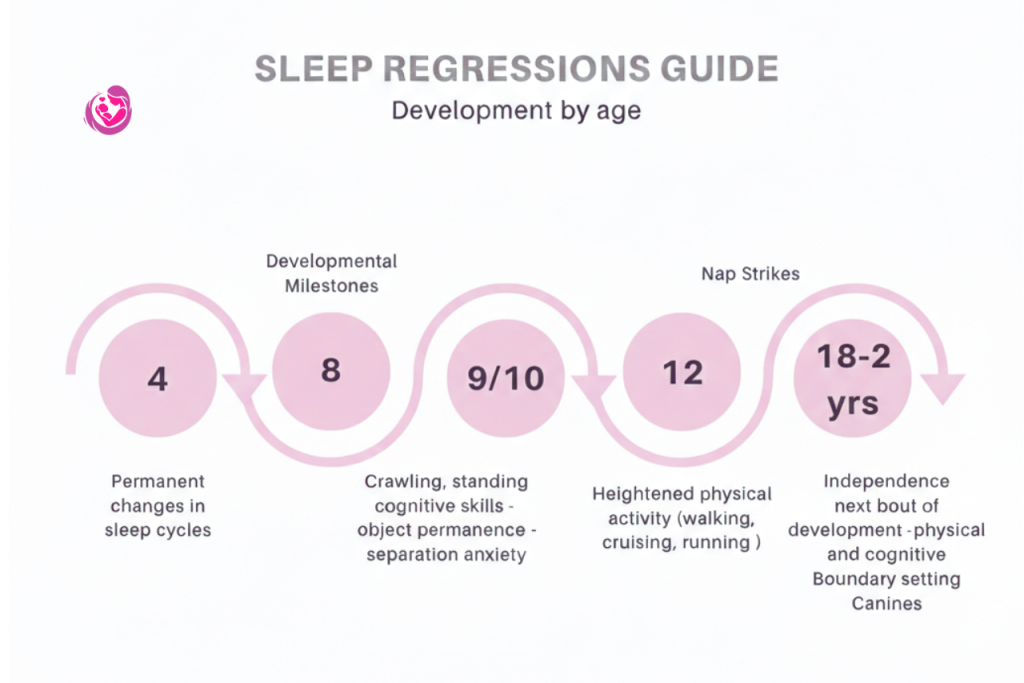
| sleep regression ages | Primary Cause | Duration | Key Strategy |
| 4 Months | Biological sleep cycle change | Permanent shift | Teach independent sleep (Self-soothing) |
| 8 Months | Crawling & Separation Anxiety | 2–4 Weeks | Practice motor skills during the day |
| 12 Months | Walking & Nap Resistance | 2–3 Weeks | Don’t drop the second nap too early |
| 18 Months | Defiance & Teething (Molars) | 3–6 Weeks | Set firm boundaries & offer a lovey |
Sleep Regression Months
In order to obtain the specification of the sleep regression ages we should obtain the meaning of that which is biologically occurring. sleep regression ages Sleep regression ages is a phase (usually 2 to 6 weeks) during which a previously normally-sleeping baby suddenly develops frequent nocturnal awakenings, is no longer capable of sleeping or is taken on protest naps.
Heavy infant interruptions always differ in every baby, but they are likely to have a predictable order in terms of human development milestones. The largest hot zones are:
The 4-Month Period: The Permanent Modification of the Sleep Architecture.
The 6-Month Mark: the child at this age should be routine attached to solid food and is able to sit up.
The 8 -10 Months: Triple Threat of crawling, teeting and separation anxiety.
The 12- Months: the Walking interference.
The 18-Month Mark: The phase of Independence and testing the limits.
This is normally done by the maturation of Hypnogram. Since infants cease to be babies, their sleep regression ages patterns will evolve to a more complex four-stage process, adults.
As the baby continues with these bouts, the baby falls into a state of light sleep. They will not fall asleep alone and hence they will be awake completely as well as demand what they used to when they fell asleep in the first place (rocking, feeding or a pacifier).
4 Month Sleep Regression
The reason why the 4-month regression is most familiar is because it is the only one that is not a regression to some extent, it is an irreversible development. You will never see your baby relapsing into newborn sleep.
The Biological “Upgrading”
The brain starts producing its melatonin at the time of four months of age and has an enhanced circadian rhythm. The present sleep regression ages patterns of the baby are:
Stage N1: Drowsy stage, easy to wake up.
Stage N2: Light sleep which slows the heart rate.
Stage N3: Stage of profound restful slow-wave sleep.
REM: Dreaming-REM: It is the stage whereby the brain makes memory into action.
The problem? The children of this sleep regression ages are still dependent on the sleep aids. When you rock the baby up, and put him down, he or she wakes up in Stage N1 (45 minutes later) and notes that the rocking has ceased and he or she wakes an alarm.
Key Milestones at 4 Months
Rolling: It is first roll also. The physical craving to roll is so great that the babies would repeat the act even when they are asleep, wake up and others got furious because they were lying on their backs.
Vision Boost: They are able to see far into the room and much better. The nursery shadows are also interesting and they are able to make their falling asleep less monotonous.
8 Month Sleep Regression
The most prevalent is the 8 months sleep regression (that usually takes place during the months 8 to 10) that can be the most physically challenging to the parents. It is power motivated by gigantic eruption of physical strength.
The Milestone “Triple Threat”
Motor Skills: The majority of the babies at sleep regression ages are learning how to walk on their hands and knees, scoot or drag themselves to a standing posture. The brain is too preoccupied with these new neuron connexions and fails to detect the signal of sleep.
Object Permanence: It is the cognitive development that a baby learns to be the case whereby when he/she is out of the room, you are still there. This generates the Separation Anxiety. They cry because they desire you, and not because they are fatigued.
Language Development: They are also starting to group the sounds. The babble is less spontaneous and they get a chance to spend an hour in crib and talk to the stuffed animals rather than napping.
The Nap Transition
The majority of babies are prepared to take a 3 rd nap when they are about 8 months of age. By attempting to hear the third sleep, it is likely to move the bedtime too late, and this leads to the fact that the body becomes overtired and synges cortisol and adrenaline and, as a result, the baby almost sleeps.
12 Month Sleep Regression
You have a toddler due to your congratulations! However, the sleeping habit is bound to experience the same flinch as you are blowing out the first birthday candle.
The Walking Strike and Standing Strike.
The 12 months regression is nearly connected with the giant procedure of walking. It is consuming titanic brainpower to take a walk. On one side of the crib, you would be able to find a toddler who would be wide awake at 2: 00 am. They are in a “learning loop.”
Common Misconceptions
One of the biggest errors, which the parents commit at the age of 12 months, is the fact that the child should receive only one nap. They are permitted to skip two weeks strike consecutively as long as they do not do morning nap, but this is on temporary basis. The majority of the professionals state that the two naps should be sustained until a child reaches the age of one that is more related to the age of 14 or 15 to prevent the sleep deprivation that would be referred to as chronic.
18 Month Sleep Regression
It is the one that is usually referred to as the most difficult sleep regression ages when it comes to parents. Why? This is because your child had grown up with the sense of will power and rebellion since he was the age of 18 months.
The Discipline Milestone
When he/she is 18 months old, the toddler knows No. They are pushing it to the limit to know what will occur. When they scream at bedtime and you come back and rock them five more minutes they have learned that they need to scream. It is not a more of a biological one but behavioural pattern.
Fears and Imagination
This sleep regression ages is also characterised by the acquisition of night nightmares. Their fantasy is growing, and the dark can be frightening, possibly.
Physical Factors
The 18-Month Molars: the largest teeth, which may bring about much inflammation and soreness of the gums.
More Pro-Social: They desire to be included in the action and they are experiencing a FOMO ( Fear of Missing Out ) when you are still up when they have to fall asleep.
Regression dealing: Premium Strategies.
The Pause Method: Your infant does not need to rush to get to him shortly when he wakes up. Give them 5-10 minutes. They are simply in most cases just going through their proceedings and will go back to sleep in the event that they are left alone.
Maximized Floor Time Provide as much time during the day as possible to the baby to practise rolling, crawling or walking. On the one hand they will be spared the system by day and fewer would be the chances of them being turned into a night practiceer.
Red Light Trick: To ensure that your toddler falls asleep a red-coloured bulb must be used. Red light does not prevent the melatonin production, but the blue or white light can be utilised to wake up the brain.
The Cheque-In Routine: The procedure which was followed previously must be employed in older toddlers; I will return and cheque on you in five minutes, unless you maintain your silence in your bed. This allows separation anxiety in the absence of a new sleeping prop.
(FAQ)
1.What is the duration of the regressions in the sleep?
Whichever way, a regression can be 2 weeks- 6 weeks. By the time it still exists, probably, an intermediate disturbance has been turned into a stable sleeping habit or prop, and it would have to be changed by changing the schedules.
2. Is teething associated with backsliding in sleep?
The teethering brings about disruptions but the veritable sleep regression ages is a neurological regression. Tetinging process is not characterised by severe painful conditions (several days) as the tooth perforates the surface. And the time of the wake is a month, but not the teeth only.
3. Will I step backward to rocking my baby or feeding him?
Try to avoid it. Although it is a fast remedy in the sense that it is given just once a night it is prone to dependence which can even take months after the regression process is done. Keep to your routine as far as you can.
4. Is the 4 months regression a long term one?
Yes, because it has changed the sleep regression ages patterns of your baby permanently. They have their sleep regression ages patterns like adults. They will not simply come out of it, they will need to learn to live within these new cycles.
5. And what I would know is that it is regression or that it is my ailing baby?
Place cheque on the red flag symptoms, which include fever, ear pulling (ear infection), tiredness, or wet diapers (few). As the baby is jolly in the day and diabolical in the night, it must be some regression.
6. He or she should drop, my baby is 6 months old?
Majority of them are on a three naps schedule at the asleep regression ages of 6 months. Nevertheless, they will be willing to switch to two longer naps, when they are having problems with third nap and they are pushing bedtime beyond 8: 30 PM.
7. What is wrong with my infant of one month crying?
It is more than usually the pinnacle of the separation anxiety. They get up and see that you are absent and have some component of panic. Lovey (above 12 months) can be useful to give or short cheque-ins can be made frequently.
8. Is it possible to sleep-train in a regressed form?
Yes, most so in the 4 month regression. Indeed, the solution to the 4-month shift is independent sleep skills. To regress in future you need to wait till one has already attained some physical mark (the first week of walking).
9. My 18 months crawling out of the crib. Is it a sleep regression ages?
Naturally sleep regression ages a drive towards independence. In the event that this happened then it would be prudent to ensure that the mattress is at the lowest. In the event that they prevail, it is high time to move to toddler bed, so that they are safe but this only leads to further regression.
10. Are not every baby subjected to all sleep regression ages?
No. Some neurological changes are hyper sensitive to babies whereas others seem to be indifferent. No, not because it is on the calendar the sleep regression ages will be expected!–do not panic!
Leave a Reply