
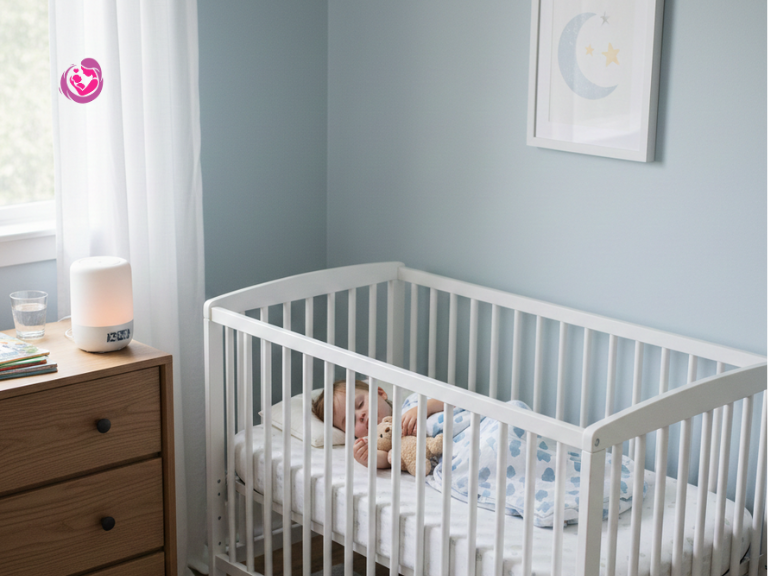
Introduction of toddler sleep training

Wonderful advances are observed in the shift between infancy and toddlerhood that involve taking a first step, uttering a first word and personality building. But there is a more sad landmark which, too, is most generally met with in this period; the sleep regression toddler sleep training is not a different variant of toddler sleep training a six months old on the other; a complex psychological ballet game between the need of a child to become independent on one side and the biological need to sleep on the other side.
sleep training toddler stage burnout can be more stressful to the parents in the USA and the whole world as compared to the stage of a new born. Whereas feeding an infant makes him/her to be awake, negotiating with a toddler makes him to be stubborn. The toddler sleep training at this stage is to establish firm and loving boundaries. This is to teach your child that the bed is a safe place and that you can fall asleep and that it is a skill that you possess. The formation of such habits today is preventing you chronic sleep deprivation that leads to behavioral problems, weaker immune systems, and more parental stress.
toddler sleep training
Talking of toddler sleep training the paradigm shift of the child development should be mentioned. When a child is two years of age, he or she is full of emerging sense of self. They also get to understand that they do not need their parents, and so the paradoxical emotion of the need to be independent and the fear of losing their parents simultaneously. It is because of this that a toddler sleep training plan does not just require the use of a crib and a monitor, but a psychological plan.
At this stage, children are good stallers. They use their new language to request to be served another glass of water, another storey or a specific stuffed animal. That is what is known as curtain calls in pediatric circles of sleep disorders. As the individual parent is constantly exposed to such acts of demands, then the parent is unconsciously reinforcing intermittent reinforcement- the most powerful of psychological motivators. The child is made to understand that the tenth time may be the yes when he/she may ask ten times. The goal of effective toddler sleep training is to break this cycle when the rules of the night will never be changed regardless of how the child will negotiate, etc.
when can you start sleep training
The question that most popular among the parents is asking whether they missed the boat or not when they never trained the child since the moment the child was an infant. The matter is that you may start toddler sleep training anywhere but the manner in which you do it depends on the child development. Most of the scholars point out that the best stage of sleep education in the toddler stages is unrestricted at the age of approximately 15 months up to the age of three.
You need to consider starting at a point where the current sleeping habit can no longer maintain the health of the family. When your toddler has to be rocked hours, when it no longer makes sense to feed him at night, when he is searching his way into your bed each night against your will, you need to do something about it. But everything is timing.
The initiation of any type of toddler sleep training programme should not be carried out when the company is undergoing a high level of upheaval. When you are altering the house, have a new daycare, or the child already to the high fever or ear infection you have to wait till a time that comes out to be boring, which is a period of two weeks. Such uniformity provides the child with the emotional support that he/she needs to deal with the change in his/her night time routine.
sleep training techniques
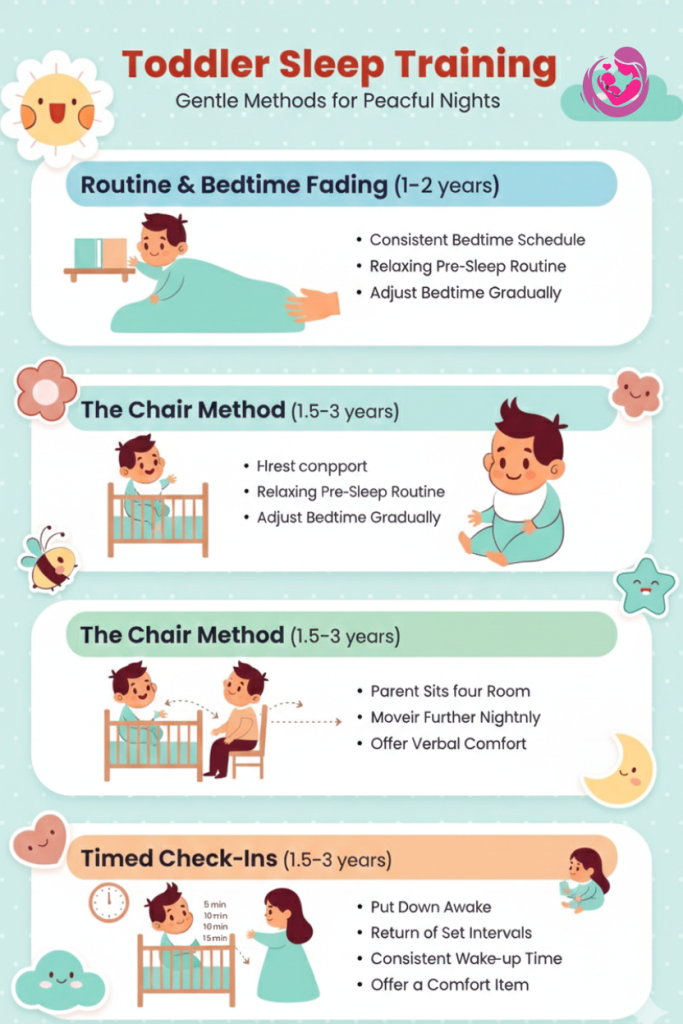
Methods that are more toddler-specific are more focused on communication and slow transitions. One of the most effective methods is the Chair Method or the Camping Out method. In this case, the parent sits in a chair next to the sleeping of the toddler till he/she falls asleep. The parent will also move the chair closer to the door and later on to the hallway after every few nights.
The toddler sleep training is quite popular in the USA due to the fact that it is a combination of parental and infant presence and promotes infant self-sleep. It produces the least of the panic of separation and requires of the child of falling asleep without any touching or holding the hard work.
The other one that is most notable is the system of Bedtime Pass and it is particularly effective with children in the age of between two to four years. You charge you child with a real card or pass, which he is permitted to cash in, once a night after lights out, after a real demand, like a visit to the bathrooms or a last hug. Passing of the pass results in the loss of the pass at night.
This will make the toddler feel in control and make choices hence reducing the protests overall. To the less discerning the Stay and Support technique allows the parent to remain in the room, but not participate in the play or discussion, as an uninteresting presence that comforts all on its own.
How to Sleep Train a Baby and vs. a Toddler
The fundamental difference between the way of toddler sleep training and a toddler has to do with the mobility and comprehension of a child. The parent is working with a biological rhythm when training, as with the six-month-old; the parent is working with a relationship as with the toddler. Physical limits are normally set, by keeping babies in a crib. A toddler especially in a large kid bed has physical capacity to move out of the room therefore making it hard to train
The environment is supposed to be perceived as the cage in the case of a toddler. This may include installing a tall baby gate in the bedroom door or entirely toddler proofing the room to ensure that the child is safe should he/she decide to play with the floor instead of sleeping.
Besides, you lack a way of communication with an infant. In order to prepare a toddler to make the transition, one may employ Social Storeys, which are simple and illustrated books that you draw about the new rules concerning the bedtime. You can give the reason why you should sleep in the form of how the sleep makes them be strong, and gives them power to visit the park the following day. This is the verbal toddler sleep training of the older children which is the secret of success.
how long does sleep training take
The duration of the educative process highly depends on the type of the child and full uniformity of the caregivers. In the majority of the cases, the drastic differences are typically logged in between three and five nights when a more direct approach is used by a parent like Cheque and Console. However, the new habits may take fourteen days to be fully developed when there are less abrupt strategies like the Chair Method.
The Extinction Burst has to be ready. It is a behavioural phenomenon that is recorded as becoming significantly worse and disappearing. During the third or fourth night, a toddler may scream more and cry than he or she cried in the initial night. Their death struggle is to know whether the old rules are applicable or not. Extinction burst makes most parents give up since they believe that the technique is failing.
But, should you happen to know how to withstand this outcry of protest, there is then no chance of the child yielding to the new ways before nightfall. Two to three weeks of perfect consistency makes the difference between complete control of sleep, including the ability to deal with the occurrence of waking in the middle of the night without some sort of intervention.
| sleep training 2 Years old | Parental Presence | Best For… | Expected Results | Level of “Protest” |
| The Chair Method | High (In the room) | Children with severe separation anxiety. | 2–3 Weeks | Low to Moderate |
| Check & Console | Periodic (Timed) | Parents who want boundaries but aren’t ready for “Full Cry.” | 7–10 Days | Moderate |
| The Bedtime Pass | Low (Minimal) | Older toddlers (3+) who “stall” with endless requests. | 5–7 Days | Very Low |
| Silent Return | Active (Physical) | Toddlers who have transitioned to a “Big Kid Bed” and keep escaping. | 3–5 Days | High (Physical) |
| The Stay-and-Support | High (Physical) | Sensitive children or those transitioning from co-sleeping. | 2 Weeks+ | Low |
| Extinction (CIO) | Minimal | Parents needing the fastest results for an overtired child. | 3–5 Days | High |
FAQS
1.Is it already late to toddler sleep training because he/she is 3 years old?
It is not possible to practise healthy sleep hygiene at too late an age and expect to achieve success. The 3 year old is also more logical in his or her thinking though he or she has greater will power. You can be motivated to stay in bed through reward systems: sticker charts or a morning surprise will serve. It could be more of a waiting game and the cognitive maturity of a 3 year old could actually play in your favour.
2.What of a toddler that inadvertently gets out of his/her crib in the process of toddler sleep training?
Safety is the priority. It is not safe anymore when your toddler breaks out of the crib. At this moment, you will have to replace them with a toddler bed or even with a floor mattress. They can be locked in their room using a child-proof handle cover or door gate. Create a closed and safe sleeping environment.
3.Does toddler sleep training cause more long-term emotional harm or damage or does it cause attachment issues?
Through a lot of paediatric research it has been seen that there are no long terms adverse effects on the emotional development of the child and his or her attachment to the parents. The children are animals that live on rules and expectation. Constant sleeping pattern conferred by a parent in fact makes them safe and trusting to the parent.
4.How will I react when my toddler wakes crying because he or she had a nightmare in the course of a toddler sleep training?
During toddler stage, nightmares take place due to strong imaginations. You must certainly reassure the child in case he or she has an actual nightmare. Go in and have a quick cuddle with them and say that they are fine. On having calmed, take them back to bed. This is to be comfortable but without creating a new prop on which you have to spend the whole night.
5.What should I do to ensure my toddler does not keep me up till 5.00 AM in the morning?
Extravagant drowsiness is expressed in early rising. It will likely appear contrary to common sense, but the sooner a toddler will be slept (30 to 60 minutes), the more chances that the toddler will be able to sleep later. Furthermore, ensure that your room is blackened by use of blackout curtains because a single ray of the morning sun is sufficient to remind the brain of a toddler to wake up.
6.Is a toddler clock that changes the colours at the waking-up time allowed?
These are certainly very recommendable to the toddler age group. Children cannot understand time at this age hence a visual reminder (light changing to green) will tell them when the time is appropriate to leave their room. It does away with the parent that is the bad man and the clock that is the bad man.
7.Then, how will I toddler sleep training, and then can I share a room with them as well?
This is because toddler sleep training is complicated but not impossible when there is room sharing. A child can be made to have a privacy space through a visual barrier of a screen or a heavy curtain. You are to attempt to be quiet at bed time. Assuming that the child rises and sees you, you must employ a steady, boring sentence like it is still night-night time and you must not speak or look.
8.Will my toddler drop his or her naptimes when I embark on a toddler sleep training programme?
Actually, the naps are usually supplemented, using the nighttime toddler sleep training As soon as a child learns to fall asleep on his/her own, he/she can apply the same to daytime sleep. The nap routine should be as routine as possible throughout the training phase because the child ought not to get overtired during the night training and this is very challenging.
9.How about sickness or teething during toddler sleep training?
Provided that your child is indeed sick, you should stop the training and take care of your child as much as they choose to, in case of fever, vomiting, or difficulty breathing. Once they are well back to the toddler sleep training. When it comes to minor teeting you can give pain killers but, as much as possible, you should follow the sleep plan like your paediatrician would suggest but only up to a certain limit.
10.Why do I have a hyperactive toddler when he/she is not getting enough sleep?
The toddlers are not always likely to be sleepy when they are fatigued; this is due to the fact that their bodies produce adrenaline and cortisol to keep them going. This leads to overtiring which is hyperactive, tantrums as well as physical clumsiness. These hormones are controlled by toddler sleep training the child on sleep which ensures that the child gets the 11-14 hours of total sleep that the child needs within a 24 hours time.
Leave a Reply